

Somewhere in every tender file, there is a line that reads "design life 25 years." It takes four seconds to read, and it decides everything that goes wrong in year twelve.
Engineers who evaluate river structures already know the uncomfortable part. Two dams can carry identical specifications on paper, be commissioned in the same financial year on comparable reaches, and then diverge completely. One is still holding full design head through the pre-monsoon season with a maintenance file thinner than a tender document. The other has a department that writes letters to a supplier that has stopped manufacturing that membrane and cannot supply a replacement.
So the honest answer to how long an air filled rubber dam lasts is somewhere between fifteen and thirty years. The gap between those two numbers has very little to do with rubber and almost everything to do with who fabricated it, how it was fabricated, and whether that party is still accountable long after the defect liability period has closed.
Bridgestone, writing in International Water Power after twenty-one years of operating experience with inflatable weirs, projected a service life beyond thirty years for the rubber membrane, crediting a thick EPDM-rich outer cover engineered to resist ultraviolet exposure, ozone, and heat. A well-engineered membrane built from vulcanized EPDM and nylon layers typically serves for 25 to 30 years in the field.
Now look at the other end of the same market. Catalogue-grade inflatable rubber dams from volume suppliers are openly listed with a designed service life of fifteen years, some in a band of fifteen to twenty-five. That is the same product category delivering roughly half the working life. On a structure that costs a fraction of a barrage but carries the same irrigation command, the difference between fifteen and thirty years is not a procurement detail. It is an entire replacement cycle inside one officer’s career.
Very few bladders fail because rubber simply got old. They fail for reasons that were fixed long before the truck arrived at site.
EPDM is chosen for its resistance to ultraviolet light, ozone, and heat aging. A thinner or diluted outer cover ages faster in Indian summer conditions and abrades faster against bedload.
Every secondary splice and second stage vulcanization introduces a discontinuity in tensile behavior. A single piece vulcanized body has no obvious weak zone. A heavily spliced one does, and the river will find it.
Many structures are decommissioned while the rubber is still sound, because corroded clamping plates and anchor bolts have failed at the concrete interface. GFRP clamping plates with galvanized fasteners remove that failure mode entirely.
Published finite element research on the remaining service lifetime of inflatable rubber dams found that deep hole damage of around seven millimeters, typically caused by improper maintenance, is enough to accelerate material degradation toward catastrophic failure. A puncture nobody inspected is not a cosmetic issue. It is a countdown.
Overinflation, delayed deflation during a flood peak, and sediment allowed to settle against the upstream toe all shorten life quietly and cumulatively.
When departments compare one option against another at this stage, the comparison is usually framed as a cost question. It is a life span question wearing a cost question’s clothes.
The first fork is the inflation medium. A water inflatable rubber dam holds a standing water column inside the bladder, which means sediment ingress, freezing exposure in high-altitude reaches, slower drawdown, and a heavier structure sitting on the same anchorage year after year.
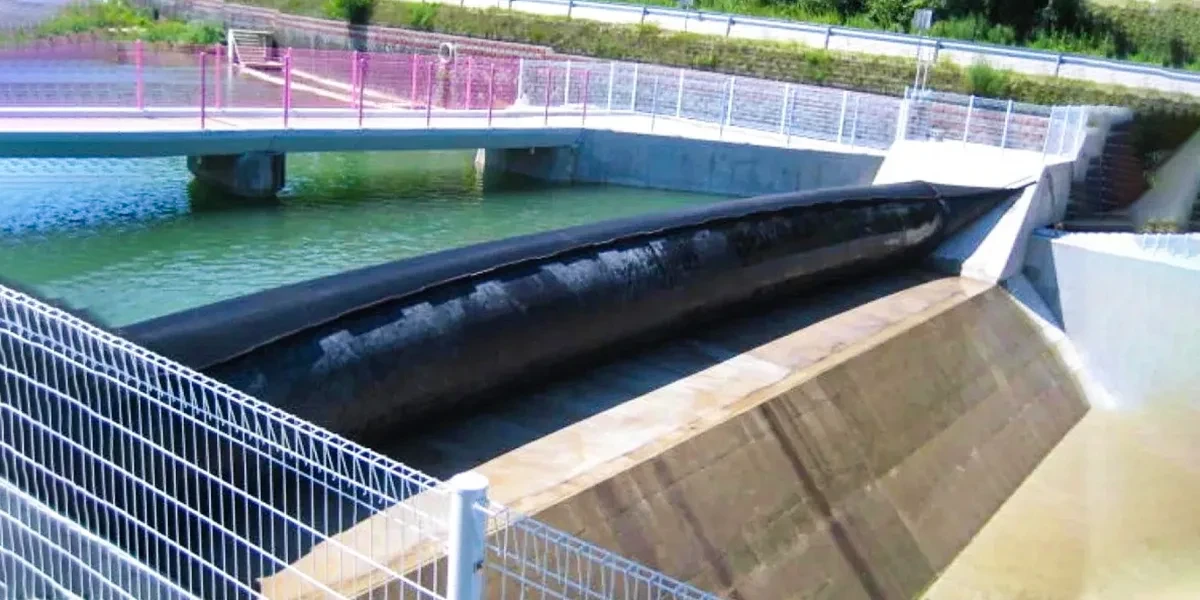
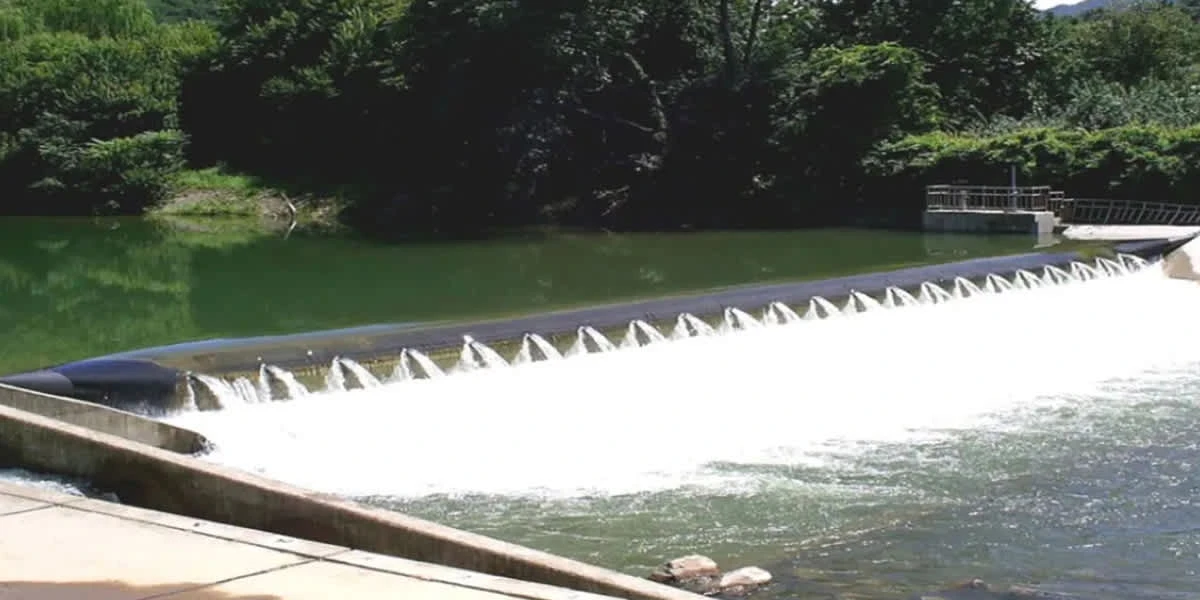
An air filled rubber dam carries only pressurized air. It moves from zero to maximum height in thirty to forty minutes and flattens against its raft just as quickly when a flood arrives. Less mass, less internal contamination, faster emergency response, and considerably less fatigue on the anchor line over three decades of cycling.
The second fork is fabrication method: single-piece vulcanization against multi-stage splicing. The third is anchorage, single line against double line, matched to head and span rather than to whatever the catalogue offers. The fourth is control, manual operation against SCADA-linked operation where water level and pressure sensors report continuously, and small deviations get caught in week one instead of year seven.
Each of those four choices moves the life span number. None of them is visible in a price comparison sheet.
The most useful change a department can make costs nothing at the tender stage. Stop asking bidders to state a design life and start asking them to evidence one. Whether the structure on your reach ends up being an air filled rubber dam or a water inflatable rubber dam, the evidence worth demanding is identical.
That last point is where most bidders quietly go silent, and it is the single most predictive question on the list.
YOOIL Envirotech works from a straightforward position. The company has been in this field since 1989, has delivered more than 400 projects. Structures such as the Gorakhpur and Sihora rubber dams sit in Indian rivers under Indian sediment loads and Indian monsoon behavior, not in a brochure.
What matters more for life span is the operating model behind those numbers. Design and execution are handled by an in-house team that stays with a project from inception through commissioning; the bladder is built from vulcanized EPDM and nylon layers, and the anchorage uses GFRP clamping plates with galvanized fasteners so the metal does not become the weak link before the rubber does. Operation runs on air alone, with no lifting machinery and no moving parts to jam under peak flood pressure, and SCADA integration is available where a department wants continuous visibility instead of periodic inspection.
Across all rubber dam types, the factor that moves service life furthest is not the category printed on the drawing. It is whether the organization that engineered the structure also built it, installed it, and expects to still be answering for it in year twenty. Five practical consequences follow from that.
When fabrication, design, and execution sit inside one organization, a performance question in year nine has one address. Imported bladders assembled by a local contractor generate a correspondence trail instead of a repair.
Three hundred plus commissioned rubber dam projects send information back into the factory about how membranes behave against real bedload, real UV exposure, and real operating habits. That learning reaches the next bladder only if the same company builds it.
Domestic manufacturing under Make in India means a replacement section or a clamping component is a production decision, not an import inquiry against a discontinued catalogue.
Span, head, sediment profile, and afflux limits differ on every reach. In-house engineering allows the structure to be built to the river’s data rather than to the nearest standard size, and undersizing is one of the quietest causes of early wear.
A department can send officers to the facility, watch the vulcanization, and see the material it is about to install for twenty-five years.
Life span is not a property of rubber. It is a property of the decision made at the specification stage, and it stays fixed for the next quarter century whether or not anybody revisits it.
If an air filled rubber dam is being considered on your reach, the useful next step is not a quotation. It is a technical conversation around your actual river data, your command area, your flood hydrograph, and your operating capacity, followed by a visit to a commissioned site and to the plant where the membrane is made. YOOIL Envirotech is set up for exactly that kind of conversation, and the projects page is a reasonable place to start before anybody talks commercially.
Sources referenced