

Ask a plant manager what worries them during monsoon, and the answer is rarely the turbine. It is what floats towards it. Logs, water hyacinth, plastic sheeting, uprooted saplings, all arriving together, usually at three in the morning, usually at full spate. That is the moment the choice between a debris barrier and a trash rack stops being a specification exercise and becomes an operating problem. Both sit upstream of the intake. Both are sold as intake protection. But they work on opposite principles, and treating them as interchangeable is how sites end up with bent racks, forced shutdowns, and a maintenance bill nobody put in the budget. So it is worth settling properly.
Start with the physics. A trash rack is a screen. It sits at the intake face, usually inclined, and stops anything larger than its bar spacing from reaching the turbine or pump. It is the last line of defence and it works by blocking flow.
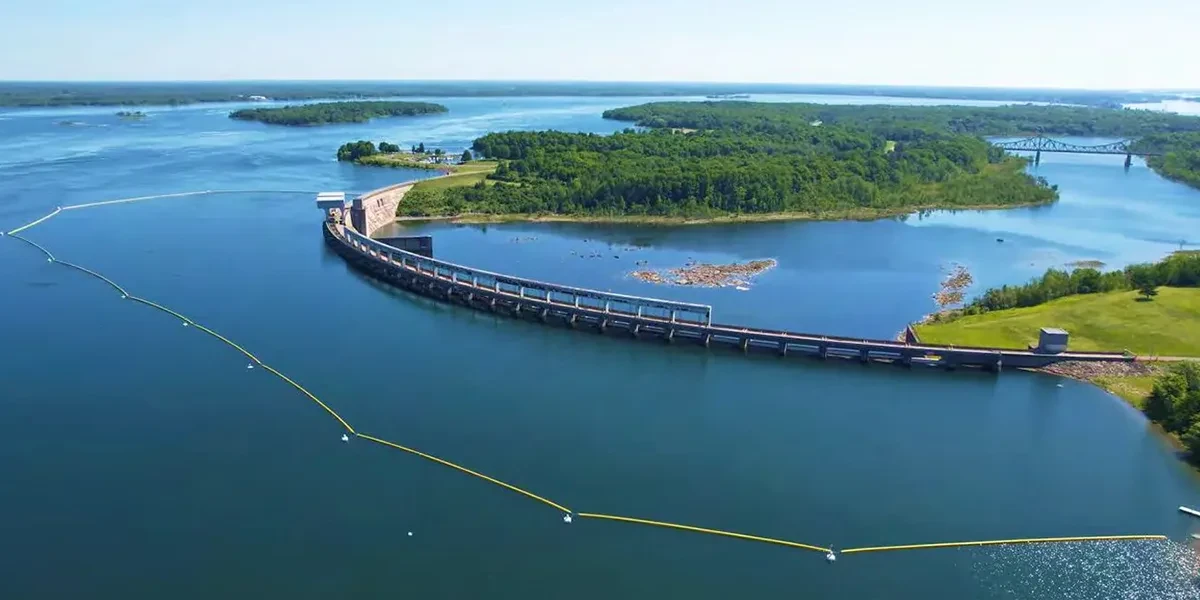
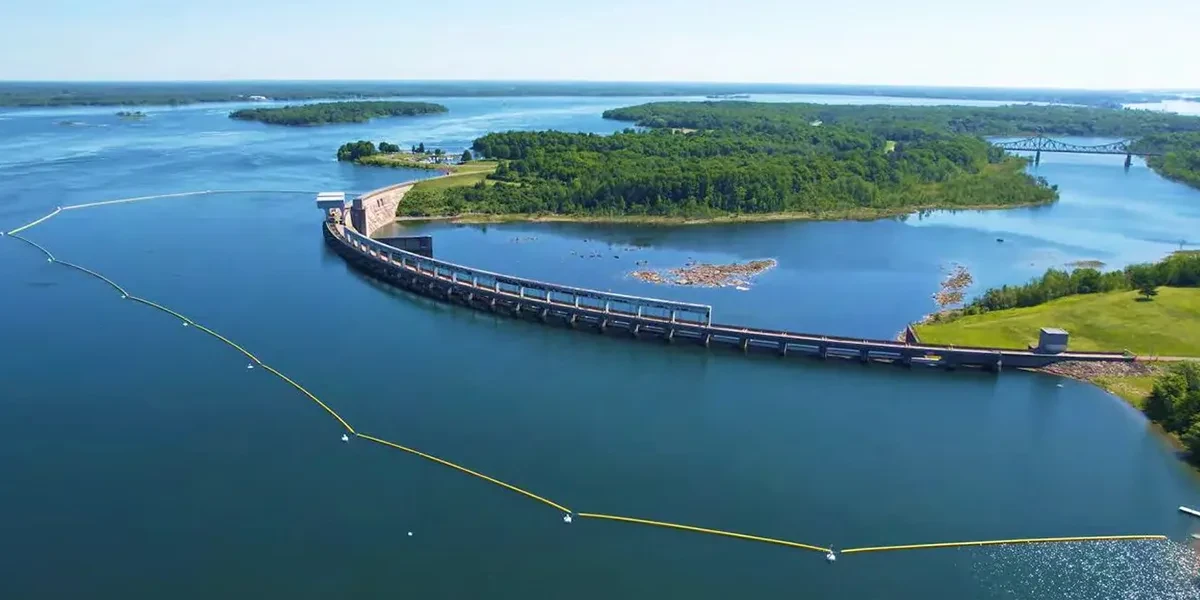
A floating debris barrier works earlier and works differently. It is a surface system, moored across the approach channel or the reservoir arm, that deflects floating material sideways to a collection point instead of allowing it to reach the intake at all. It does not block, it redirects. Because the load travels sideways along the barrier line instead of collecting at the opening, deflected debris never reaches the screen to add to the head it works against.
That one difference, blocking against deflecting, explains almost every operational outcome that follows.
The numbers are more uncomfortable than most operators expect. Ales Hribernik, in Evaluation of Clogged Hydropower Plant Trash Rack Losses, published in Strojniski vestnik, the Journal of Mechanical Engineering, Vol. 66, No. 2, 2020, analysed a full year of flow and trash rack head loss data recorded at fifteen minute intervals at a single working hydropower plant. Accumulated debris accounted for close to half of total trash rack head loss even though the rack was cleaned regularly, and incomplete cleaning on its own raised head losses by 18 percent. That is one plant over one year, so it is an indicator rather than a benchmark. It is a pointed one, because head loss is not an abstraction. It is generation you have already paid for and did not receive.
Set that against the scale of what is now at stake. The International Hydropower Association's 2026 World Hydropower Outlook, released in June 2026, put global installed hydropower capacity at 1,469 GW at the close of 2025, with 28 GW commissioned during the year. Every one of those intakes has a screen in front of it. Every one of those screens loses head as it loads, and most operators absorb that loss quietly because nobody measures it.
The wider operating environment is not getting gentler either. Himachal Pradesh State Disaster Management Authority data reported in September 2025 put power sector damage from that year's monsoon at Rs 13,946.69 lakh, close to Rs 139.5 crore, against total state losses of over Rs 4,000 crore. Those figures cover all monsoon damage and are not a measure of debris impact. What they show is the intensity of flow and load that Himalayan catchment intakes now absorb, season after season.
None of this argues for removing the rack. A screen at the intake face does work that nothing on the surface can do, because it is the only thing standing between the turbine and submerged or neutrally buoyant material. Sunken logs, rolling boulders, sediment slugs and fish all travel below the waterline, and no surface water barrier will touch them. A rack also gives you a defined, certified clear spacing, which is what turbine warranties and design codes are written around.
So the trash rack keeps its job. The real question is how much work you are asking it to do, and whether the site is paying for that in head, in rake wear or in downtime.
This is where the economics turn. A floating debris barrier takes the bulk surface load out before it ever reaches the screen, and that changes three things at once.
Cleaning frequency falls, because the rack is only handling what got past the surface. Rake and cleaning machine wear falls with it. And during high flow events, when raking is least safe and most urgent, the barrier keeps working without anyone standing on a wet deck at night with a spate running.
There is a safety return as well. A clearly marked water barrier keeps boats, swimmers and stray craft out of the danger zone above a dam, and gives staff a visible line to work to. Where consent conditions or internal safety policy already require exclusion above the intake, a marked surface line is usually easier to hold than signage alone.
Intake protection and flood management usually sit with different teams, which is a mistake. Blocked waterways raise upstream levels, and an intake that jams during a spate becomes a flood risk in its own right. Flood barriers at reservoir, canal and urban drainage level are increasingly specified alongside debris control, because the two failure modes share a cause.
If a site already operates flood barriers, or is planning a flood control barrier scheme for an urban stretch, the debris system belongs inside that scope rather than bolted on afterwards. A flood control barrier that fills with vegetation in its first week has not solved anything; it has only moved the blockage.
Five questions usually settle it without a study.
The honest answer is that the question is slightly wrong. A trash rack protects your turbine. A debris barrier protects your trash rack. Ask a single screen to do both jobs, and it will do neither well, which is precisely what the head loss data has been showing for years. Put them in sequence, and the screen stays clean, cleaning cycles drop, rake life extends, and the intake stops being the thing you think about at three in the morning.
If you are reviewing an intake, a canal head, or a reservoir approach before the next season, the Yooil Envirotech team can look at your flow data, debris profile, and channel geometry and say plainly whether a barrier is justified at your site. Most of that assessment needs one site drawing and one honest conversation about what your rack is currently costing you.