

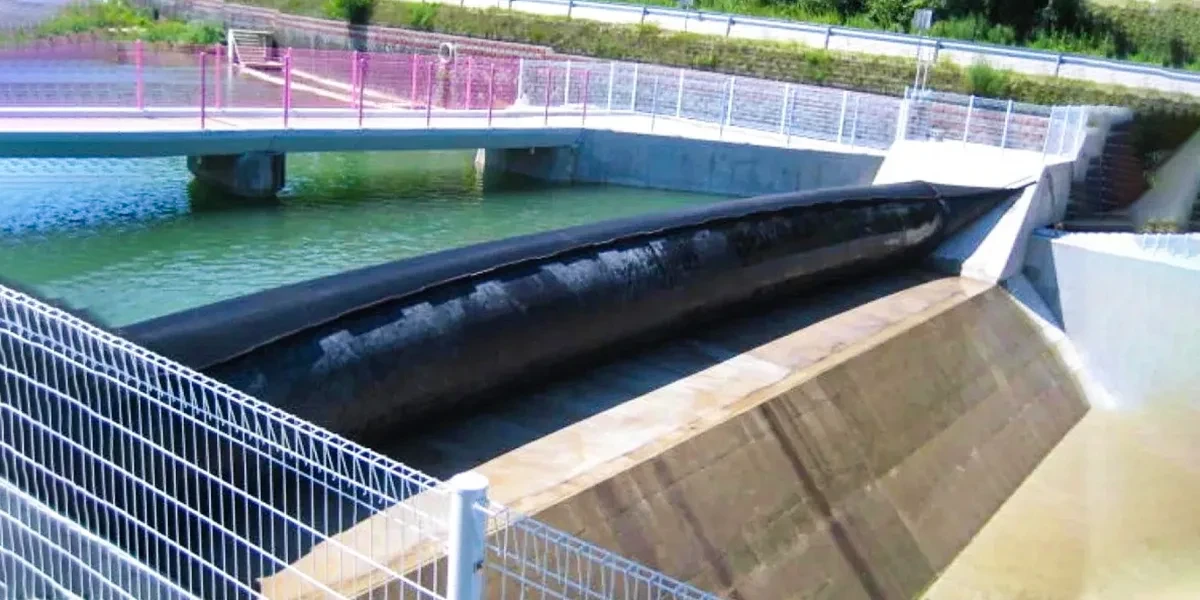
Most rubber dam failures are described afterwards as sudden. Very few are. Read the forensic reports, and the same pattern appears: a membrane ageing for years, a pressure log nobody plotted, an inspection deferred because the river was running, and then one night the structure gives way, and everyone calls it unexpected. For anyone operating a rubber dam in India, where the working window between monsoons is narrow, and the sediment load is heavy, that gap between the real timeline and the perceived one is the whole problem. So it is worth being specific about causes, signs, and prevention.
A rubber dam can stop performing in several ways, and they do not carry the same consequences.
Of the more than 4,500-6000 inflatable rubber dams that Yooil Envirotech records as being in service worldwide, the failures that make the news are the last category. The ones that quietly cost money are the first four.
Five causes account for most of what goes wrong, and only one is about poor material quality.
Rubber loses properties over time under ultraviolet exposure, heat cycling and ozone. The best documented case is Tempe Town Lake Dam in Arizona, built between 1997 and 1999 with four bladders of 16 feet height across a structure close to 1,000 feet long. At 9:44 pm on 20 July 2010, bladder number two burst and deflated immediately, draining roughly one billion gallons into the Salt River channel. The Association of State Dam Safety Officials case study attributes the failure to weakening and separation of the bladder layers under intense desert heat and related environmental factors, with the forensic work reported by Brady and Sabol in 2011. Ply separation is the point to carry forward. The material rarely fails in tension, it fails between layers.
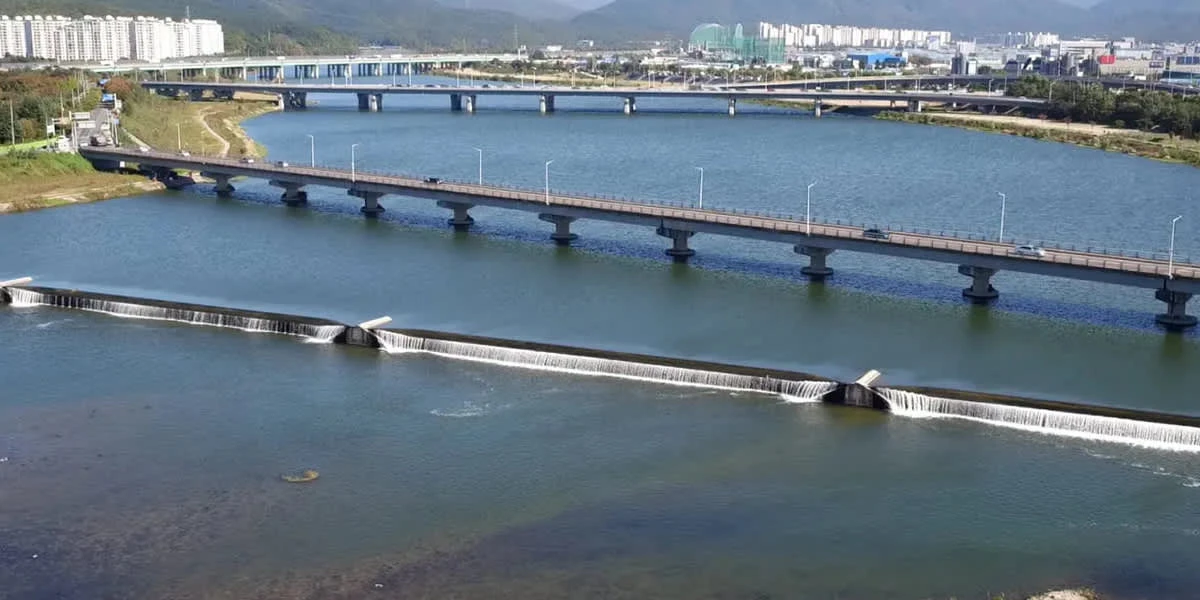
When flow passes over a partly deflated crest, the membrane can oscillate. Research on inflatable dam vibrations published through IAHR by Gebhardt and colleagues found that vibration appears suddenly within a narrow band of dam heights, disappears as deflation continues, and is linked to abrasion and the leaks that follow. Add a sediment-laden river carrying timber and the mechanism has help. Different rubber dam types handle this differently, which is why the downstream deflection fin Bridgestone introduced with its EPDM designs in the 1970s, meant to separate the nappe and suppress vibration, still appears on drawings today.
Rubber dams sit in public rivers, so sharp objects and deliberate damage are a real category rather than a theoretical one. Published work on the twenty rubber dams installed in Hong Kong records vulnerability to sharp objects as the technology's main disadvantage, and notes the ceramic chip coatings and stainless steel mesh used to reinforce the body against it.
Bolt torque, plate condition and grout quality at the fixing line decide whether the membrane is held evenly. An air filled rubber dam of the type Yooil supplies uses GFRP clamping plates with galvanised bolts to keep this line out of the corrosion cycle, but it still needs inspection, because uneven clamping concentrates stress in the membrane above it.
No moving parts in the dam body does not mean none in the system. Blowers, valves, sensors and deflation logic all sit between a flood forecast and an actual deflation, and a dam that will not lie down in time is a flood risk rather than a maintenance item.
Nearly all of these show up weeks or months before anything dramatic happens, and nearly all are free to record. On an air filled rubber dam the instrumentation you need for most of them is already installed.
None of this needs a consultant. It needs somebody writing the same numbers down in the same format every month.
The part of the Tempe case most operators skip is the sequence before the burst. Deterioration had already been identified and a bladder replacement programme was planned for early 2010. It was postponed because higher than usual flow in the Salt River meant the bladders could not be taken out of service. Crews were due to start the replacement the very next morning when the failure happened at night.
That is not an Arizona problem, it is a monsoon problem in different clothing. Any rubber dam in India works on the same constraint, because the window for safe deflation, inspection and work is set by the river and not by the maintenance calendar. If a replacement slips past that window, the asset carries the risk for another full season whether or not anyone consciously accepted it. Long lead items are best ordered against the window rather than the budget cycle, which is also why it matters who makes the bladder. Where design and manufacture sit inside the same organisation that installs and maintains the dam, a replacement membrane is a production decision rather than an import enquiry, and the schedule can be worked backwards from the dry season instead of forwards from whenever a supplier can fit it in.
Prevention for a rubber dam in India is unglamorous and largely clerical, and most of it is cheaper than one unplanned deflation.
Inflatable rubber dams have a strong service record, and the reason is structural simplicity. No gates to jam, no hoists to seize, no painting programme. What they do have is a working membrane sitting in a river, and membranes respond to sunlight, sediment, glass, vibration and time. Every failure mode above announces itself first in a pressure log, or on a surface somebody could have walked past and looked at.
If you operate a rubber dam in India and cannot plot pressure against crest height for the last twenty four months, that is the place to start, ahead of any capital decision. Yooil Envirotech works across rubber dam types with design, in-house manufacturing, supply, installation and ongoing operation and maintenance held in one scope, and an in-house design and execution team that follows each project from inception through commissioning. That matters here for a practical reason rather than a marketing one, because the organisation that made the membrane is the one best placed to judge what its condition is telling you, and the one that can fabricate the replacement when the answer is that it needs one. The team will review an existing installation's condition and inspection regime as readily as specify a new one. Either conversation is worth more before the monsoon than after it.