

Rain does not knock first. It barges in.
And in India, that matters more every monsoon. A road that was dry at 9 a.m. can turn into a brown, rushing hazard by noon. A warehouse entrance. A hospital ramp. A factory gate. A basement car park. Flooding rarely waits for a perfect engineering drawing or a five-year civil project. It arrives early, sideways, and sometimes all at once. That is exactly why the old debate needs a fresh answer. When should you build a fixed wall, and when should you choose portable flood control barriers, a smarter, faster, more adaptable system? For many Indian sites, flexibility is not a compromise. It is an advantage.
India does not face a small flood problem. It faces a recurring one. NITI Aayog notes that about 40 million hectares across the country are prone to flooding, with an average of 7.17 million hectares affected annually. The same report says average annual flood losses are around Rs 5,649 crore. That is not a one-off headline. That is a pattern. And patterns demand solutions that can be deployed where risk keeps shifting, especially across industrial estates, transport corridors, commercial campuses, and dense urban pockets.
Now look at the urban side. A 2025 World Bank report warns that the number of people exposed to a 1-in-100-year flood of 50 cm could rise from 11.1 million in 2023 to as many as 46.4 million by 2070. It also estimates current annual losses from pluvial flooding at about $4 billion, rising further by 2030 and beyond. That changes the conversation. The question is no longer, “Do we need flood protection?” The real question is, “How quickly can we put the right protection in the right place?”
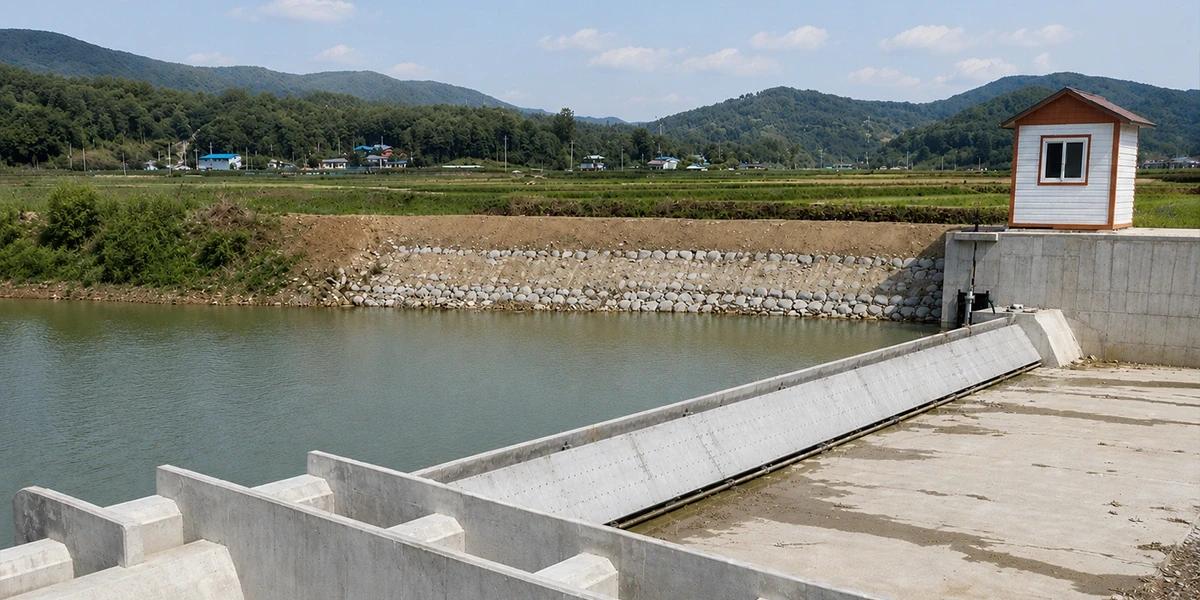
Let us be fair. Permanent flood walls have their place. They make sense where flood exposure is constant, land use is stable, and the threat profile is highly predictable. Large riverfront zones, critical infrastructure edges, and long-term public works may need that kind of fixed defense. No argument there.
But here is the catch. Indian flood risk is rarely neat. Cities sprawl. Drainage gets blocked. Basements get added. Access routes change. Low points appear where nobody expected them. NITI Aayog itself points out that centralized flood control infrastructure can be too rigid to adjust quickly to changing boundary conditions such as local floodplain urbanization. That one sentence says a lot. Strength without adaptability can become expensive stubbornness.
Permanent walls also ask for space, approvals, construction time, and often a tolerance for visual and operational disruption. For commercial properties, logistics parks, metro-adjacent developments, hotels, and manufacturing units, that is a serious trade-off. What if the flood risk is seasonal, doorway-specific, or concentrated around entries, ramps, substations, and loading bays? Pouring concrete everywhere is not always resilience. Sometimes it is overbuilding.
This is where portable flood control barriers enter the picture, and honestly, this is where the discussion gets interesting. Flexibility changes the economics of preparedness. Instead of defending every inch of a site with a fixed structure, businesses can protect the exact vulnerability points that matter most. Entry gates. Service corridors. Parking ramps. Loading areas. Sensitive equipment zones. Temporary risk can be met with temporary defense, without making the site feel like a fortress all year.
There is also the speed factor. India’s urban flood guidelines emphasize pre-positioning equipment, maintaining supplier readiness, and enabling rapid mobilization once alerts are issued. That logic aligns beautifully with modular and deployable barrier systems. When water risk spikes fast, response time becomes a design value. Yooil Envirotech can position flood solutions not merely as products, but as readiness infrastructure. That is a sharper message for Indian buyers who care about continuity, compliance, and downtime reduction.
And then there is land reality. Not every client can redesign an entire frontage. Not every facility owner can halt operations for months. A modern flood defence barrier strategy should work with the site as it exists today, not only as it might look after a major redevelopment project.
Some flood events give warnings. Some barely send a whisper. That is why passive and semi-passive technologies are getting attention across resilient infrastructure planning. An automatic flood barrier can reduce dependence on manual setup during chaotic, high-pressure conditions. When staff availability is low, when the storm hits at night, when access roads are already affected, automation stops being a luxury and starts looking like good sense.
The same argument strengthens the case for a self closing flood barrier. Human response is valuable, of course, but human response is also delayed by traffic, power cuts, confusion, and underestimation. Water is brutally efficient. Protection should be too. For sites like underpasses, underground entries, utility rooms, and vulnerable perimeter openings, self-activating or water-responsive systems offer something fixed walls often cannot: action at the exact moment risk escalates, without waiting for a team to arrive.
That matters even more in India because growth is pushing development deeper into risky zones. The World Bank found that between 1985 and 2015, built-up or settlement area grew by 102 percent in high flood-risk areas, faster than the 82 percent growth in flood-safe areas. So yes, exposure is rising. Fast. Which means flood protection must become more agile, more site-specific, and more layered.
Here is the practical truth. Flexibility wins when flood behavior is irregular, when the vulnerable points are concentrated, when aesthetics matter, when operations cannot stop, or when the site needs phased protection instead of one massive capital intervention. It wins in airports, IT parks, warehouses, hospitals, hotels, metros, schools, substations, gated developments, and industrial compounds that need serious protection without permanent visual bulk.
It also wins when decision-makers want layered resilience. A permanent wall can be part of the answer, sure. But many Indian properties need combinations: drainage improvement, warnings, elevation, and a demountable flood barrier system that can be installed only when required. That is not indecision. That is intelligent design. NITI Aayog explicitly recommends a combination of structural and non-structural measures, while giving priority to non-structural approaches where possible. That should tell every asset owner something important. The future of flood resilience is not only hard infrastructure. It is responsive infrastructure.
For Yooil Envirotech, the opportunity is clear. Speak to the Indian market not with fear alone, but with control. Not with “build bigger,” but with “protect smarter.” Because when monsoon risk changes street by street, gate by gate, and hour by hour, the winner is rarely the heaviest solution. Usually, it is the one ready to move.