

Cut a Bituminous Geomembrane in cross section and you will not find a single sheet of plastic. You will find a stack. Each layer inside that stack does one job well, and the reason the finished liner holds water for decades comes down to how those jobs are arranged. For engineers specifying canal linings, reservoir barriers, or dam waterproofing, understanding this internal architecture is the difference between choosing a product and knowing exactly what you are installing. This guide opens the material from top to bottom and explains what every layer contributes.
No single material does everything. Bitumen waterproofs beautifully but carries little tensile load on its own. A geotextile is strong but porous. Sand shrugs off ultraviolet light but cannot contain water. A multi-layer geomembrane resolves this by combining materials so that each one covers the weakness of the others. The result is a barrier with a water permeability on the order of 10 to the minus 14 m/s when measured to ASTM E96, a figure that places it among the tightest lining materials available in civil engineering. That performance is manufactured, not accidental, and it is written into the ASTM D2643/D2643M-21 specification, updated in 2021, which governs prefabricated bituminous geomembranes used as exposed canal and ditch liners.
Read from the exposed surface downward, a typical product follows a consistent geomembrane structure. Five distinct layers sit in a fixed order, and the sequence itself is part of the engineering.
The uppermost layer is fine sand pressed into the bitumen while it is still hot. It does two quiet but important things. It shields the bitumen beneath from ultraviolet radiation, slowing the ageing that sunlight drives in exposed installations. It also raises surface friction, reported at roughly 39.5 degrees to NF EN 495-2, so crews can walk safely on inclines and the liner stays stable when laid on a slope.
Below the sand sits the heart of the product: an elastomer-modified bitumen compound. This is the waterproofing engine. Elastomers give the bitumen enough flexibility to stretch over settlement and bridge small cracks in the substrate without splitting. Because the compound is dense, the finished sheet reaches a density near 1.27 g/cm3 to ASTM D792, heavier than water, which is precisely why it can be installed underwater and resists uplift during reservoir drawdown.
Embedded within the bitumen is a glass fleece, saturated by the compound during manufacture. Its job is dimensional stability. Bituminous geomembranes carry a coefficient of thermal expansion on the order of 10 to the minus 5 per degree Celsius to ASTM D696, roughly one hundred times lower than HDPE. The glass fleece is a large reason the sheet barely expands or contracts, so it lies flat and wrinkle free across hot afternoons and cold nights alike.
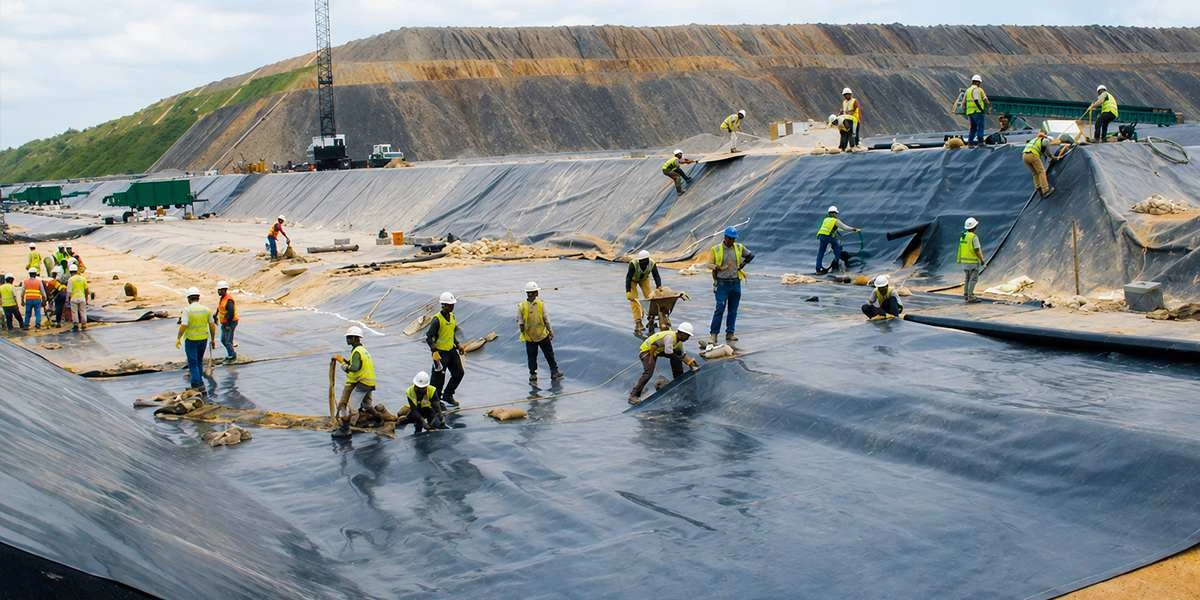
The structural backbone is a non-woven polyester geotextile that the bitumen impregnates fully. This layer supplies mechanical performance: tensile strength typically in the range of 18 to 39 kN/m, and puncture resistance around 460 N. It is the reason a bituminous geomembrane can often be placed directly on prepared ground without a separate protective fabric, and why it tolerates the occasional sharp stone or foot traffic during construction.
The bottom face carries a thin anti-root, anti-perforation film. Wherever a liner meets soil, plant roots will probe for any weakness and grow through it. This film blocks root penetration and vegetation growth from below, protecting the barrier across the long service lives, frequently several decades, that hydraulic infrastructure is expected to deliver.
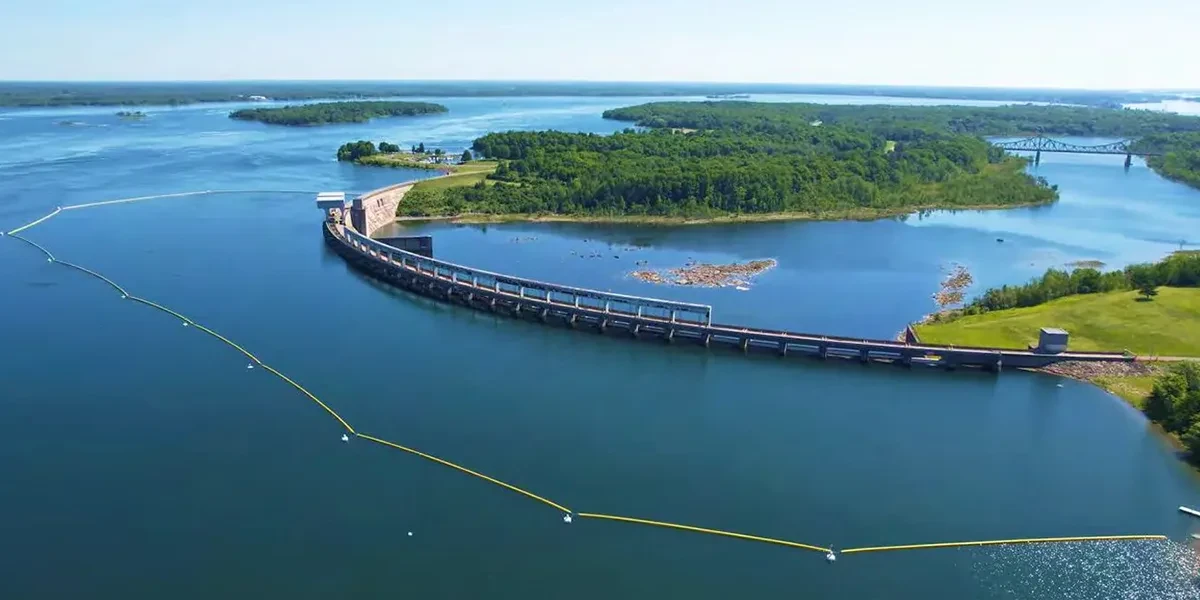
The value of a composite geomembrane is that the whole outperforms any single ingredient. The geotextile carries load while the bitumen stops water. The sand protects the bitumen while the fleece keeps the sheet dimensionally calm. The film guards the underside. Because all of these functions are bonded into one factory-made sheet, quality stays consistent from roll to roll rather than depending on site conditions. It is also why bituminous geomembranes are addressed for dam use in International Commission on Large Dams (ICOLD) Bulletin 135, which covers their application in large hydraulic structures. The layered approach is not a marketing flourish. It is the reason the material behaves predictably in the field.
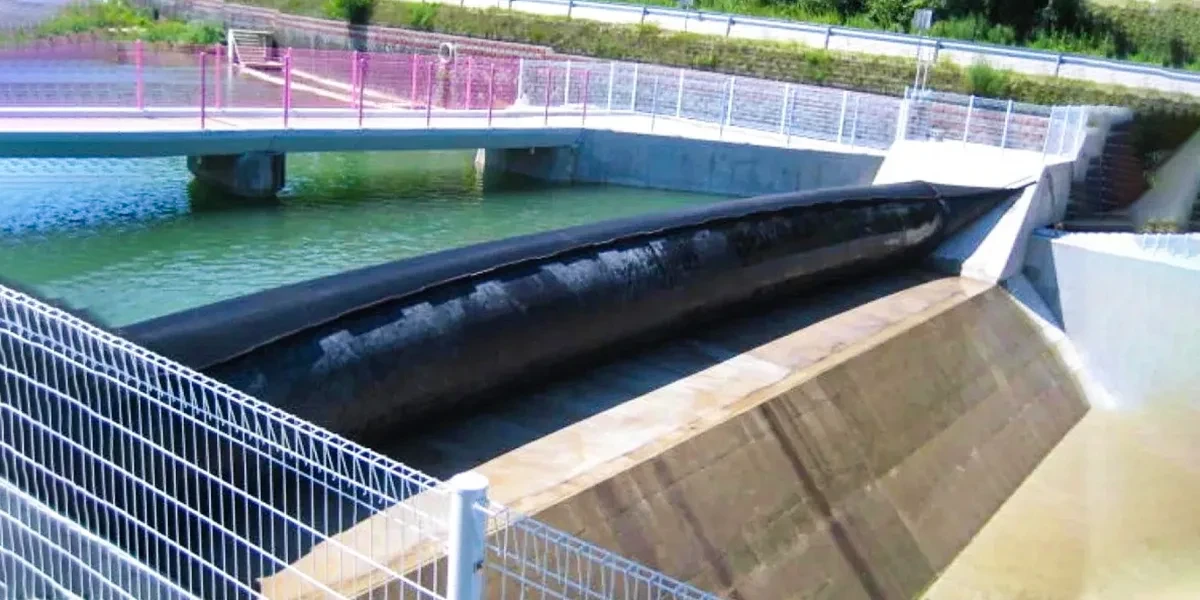
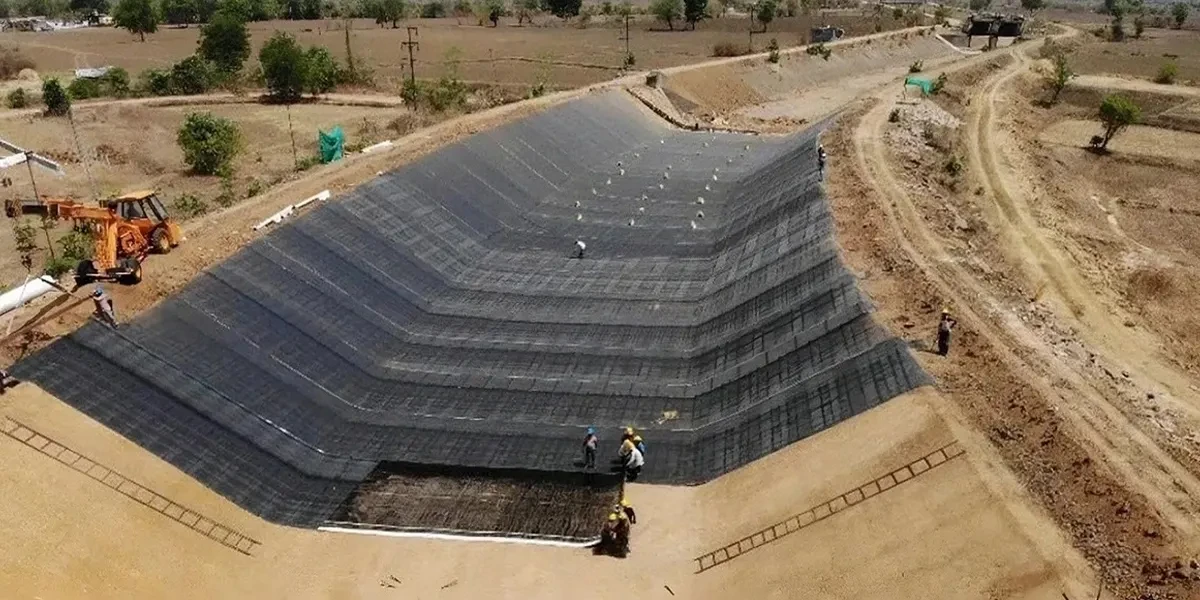
The engineering matters because the problem is large. India operates a canal network of roughly 160,000 km, of which only about 30 percent is lined, and seepage accounts for an estimated 30 to 40 percent of conveyance losses according to 2026 policy analyses. Field research published in the International Journal of Engineering Research and Technology in 2013 found that lining could cut canal seepage by close to 88 percent. A waterproofing membrane whose structure resists ultraviolet light, root growth, thermal movement, and puncture in a single sheet is well matched to canals and reservoirs that must perform for decades with minimal maintenance. The multi-layer design is what turns a laboratory permeability number into a liner that keeps working after the monsoon, through the dry season, and across the years in between.
Once the structure is clear, a data sheet reads differently. A friction angle is really a statement about slope safety. A thermal expansion figure is really about wrinkle-free installation. A density above that of water tells you the sheet can be placed submerged. At Yooil Envirotech, bituminous geomembrane linings are supplied for canals, power channels, reservoirs, dams, and mining applications with this full-stack construction in mind, manufactured to the latest technologies and specified against international standards. Understanding what sits between the sand and the anti-root film is the first step to choosing the right liner and installing it with confidence.