

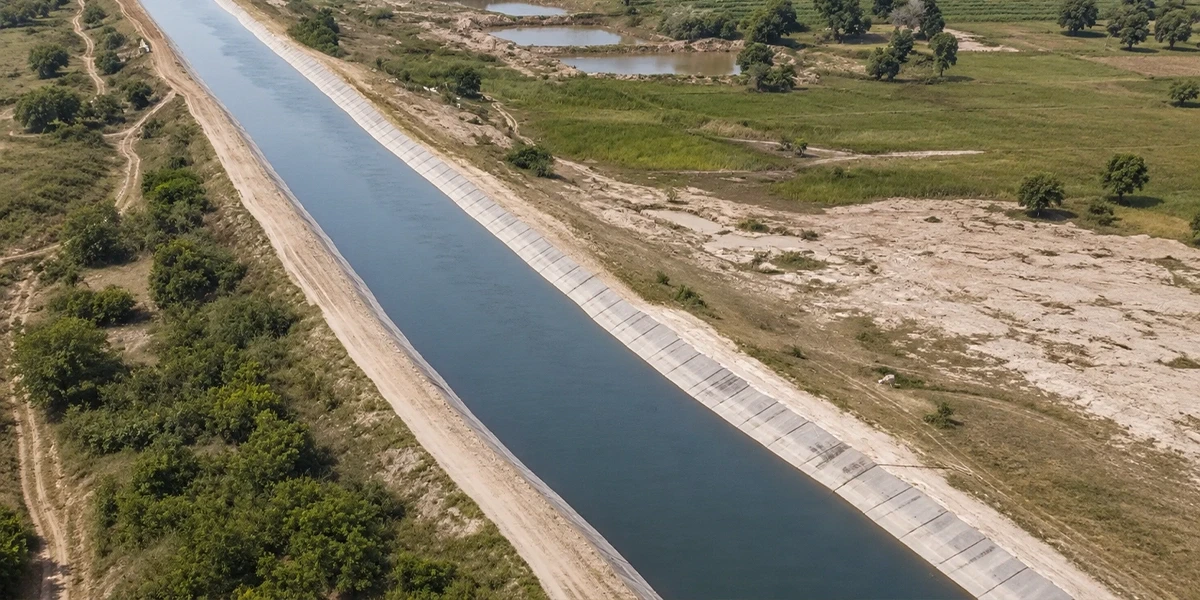
Water doesn't wait for paperwork. It finds the crack, the joint, the weak patch of soil, and it leaves. Quietly. Every single day. And in a country where canals still carry water across deserts, black-cotton soil belts, and hill terrain, that quiet leaving adds up to a genuinely massive problem.
Here's a number worth sitting with: India's overall irrigation efficiency hovers around just 35-40%, according to study material compiled by Legacy IAS, which means more than 60% of the water released from a canal head never actually reaches the crop it was meant for. Seepage, evaporation, runoff. Gone. Now ask yourself this. If you were losing six out of every ten rupees you earned, would you keep doing business the same way?
That's the question driving a quiet revolution in how India lines its canals. And right at the center of it sits a material most farmers have never heard of, but most engineers are starting to trust completely: Bituminous Membrane.
Canal seepage isn't a minor inconvenience. It's structural. It's expensive. And it's been baked into Indian irrigation infrastructure for decades.
Unlined and poorly maintained secondary and tertiary canals lose water at rates several times higher than properly lined ones, per peer-reviewed performance assessments of Indian canal systems published in irrigation engineering literature. Lined primary canals showed seepage losses as low as 0.55% per 100 metres, while comparable unlined stretches lost nearly double that. Multiply that gap across thousands of kilometres of distribution network and you start to understand why state irrigation departments are under so much pressure to act.
Here's the bigger picture, though. Canal irrigation's share of India's net irrigated area dropped from 40% in 1950-51 to roughly 22% by 2020-21, according to a 2023 assessment published in the journal Water (MDPI) on barriers to canal irrigation efficiency. Farmers simply stopped trusting canals and shifted to tube wells. That's not a small shift. That's a slow-motion crisis in water governance, and it's exactly why lining technology matters so much right now.
Concrete lining has dominated Indian canal construction for generations. It's durable, sure, lasting 25-40 years under ideal conditions. But ideal conditions are rare in real Indian soil.
Expansive clay. Black cotton soil. Wet-dry cycling that swells and shrinks the ground beneath the lining every monsoon season. Concrete cracks under that kind of movement. And once it cracks, water gets in, erosion starts, and you're back to square one, except now you've also spent crores on concrete that failed early.
This is precisely the gap Bituminous Membrane was built to fill.
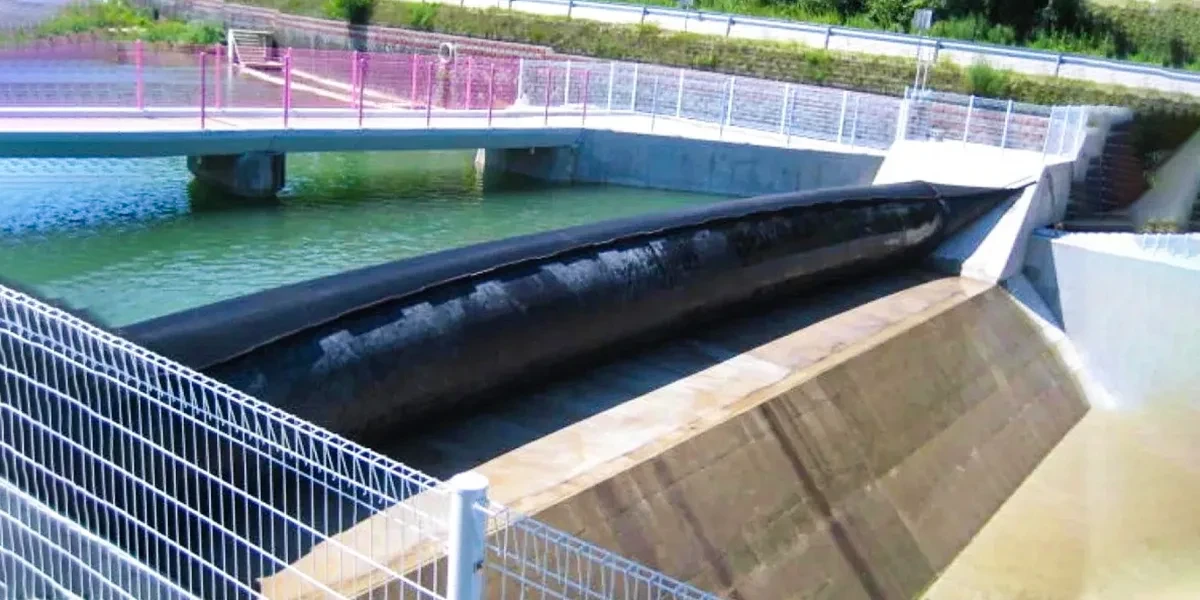
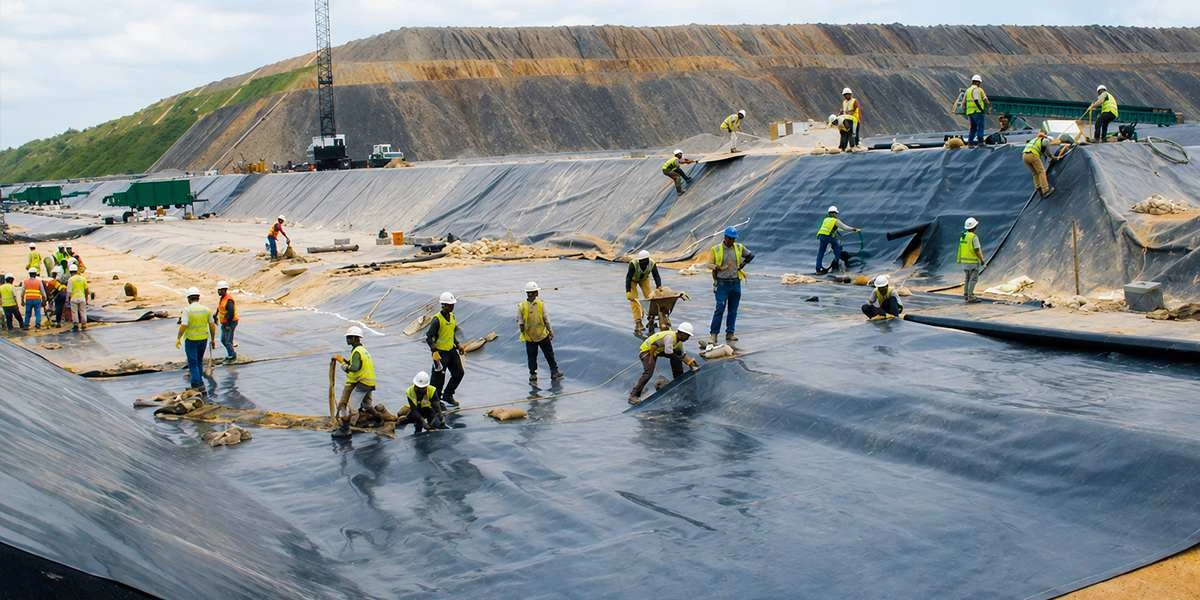
A Bituminous Geomembrane, or BGM, is manufactured by impregnating a non-woven polyester geotextile with an elastomeric bitumen compound, then coating it with sand on top for UV resistance and an anti-root film underneath to stop vegetation from punching through. Sounds technical. It is. But the result is something almost stubbornly simple: a flexible, near-impermeable sheet with permeability in the order of 10⁻¹⁴ m/s.
Think about that permeability figure for a second. That's not "low." That's practically zero.
What's fascinating, honestly, is that bitumen-based waterproofing isn't even a new idea. It was used to seal irrigation canals in Mesopotamia roughly 4,000 years BC, and sections of those ancient waterproofed canals still exist today. There's something almost poetic about a 6,000-year-old material making a comeback in modern Indian irrigation engineering. We didn't invent the wheel here. We just made it flexible, UV-stable, and puncture-resistant enough for the 21st century.
BGM doesn't behave like rigid concrete or thin polymeric sheets. It flexes with the soil instead of fighting it. Documented technical assessments of BGM in canal applications point to a low Manning coefficient for smoother, more efficient water flow, extreme puncture resistance allowing rapid deployment even over rougher subgrades, and high resistance to wind uplift, with installation possible even in winds up to 40 km/h. It also resists thermal expansion, meaning it doesn't wrinkle or buckle when temperatures swing, which is exactly the kind of stress that breaks polymeric liners over time.
Does that mean BGM is the answer for every single canal in India? No. Site soil, budget, terrain, water chemistry, all of it matters. But for canals built over swelling clays, where concrete keeps failing, BGM has shown a genuinely different result.
Real proof beats theory every time. So let's talk about what actually happened on the ground.
The first application of BGM in India was carried out on a one-kilometre stretch of the Pench Canal in Nagpur, Maharashtra, given as a pilot project to Yooil Infra to control seepage and stabilize the canal banks, as documented in a technical paper presented at the International Conference on Geosynthetics. The area sat on expansive soil that had repeatedly caused concrete lining failures, heavy bank seepage, and even breaching at multiple reaches.
The result? Seepage through that section stopped completely. No stability issues were observed afterward either, even through full monsoon flow, because the drawdown conditions that usually destabilize banks were eliminated. That single pilot stretch became a proof point for something much bigger.
This is the kind of evidence that gets state irrigation departments to pick up the phone.
The momentum behind canal modernization right now is real, and it's backed by serious money. The Union Cabinet approved an initial outlay of Rs. 1,600 crore for the Modernization of Command Area Development and Water Management (M-CADWM) sub-scheme under PMKSY for 2025-26, according to a Press Information Bureau release from the Government of India. A National Plan for Command Area Development and Water Management is expected to follow from April 2026, aligned with the 16th Finance Commission period.
Punjab alone is relining major stretches right now. The Sirhind Feeder Canal relining is underway to stabilize irrigation across roughly 98,739 hectares, and the Rajasthan Feeder Canal relining will support stabilization across nearly 69,096 hectares, per details shared by the Union Ministry of Jal Shakti in a July 2025 Parliament response reported by Babushahi. These aren't pilot-scale numbers anymore. This is national infrastructure being rebuilt, canal by canal, and lining material choice sits right at the heart of every single one of those decisions.
Where does that leave the market? Growing, steadily. The global geomembranes market is expected to reach USD 2.61 billion in 2025, climbing toward USD 3.60 billion by 2030 at a CAGR of 6.61%, according to Mordor Intelligence's industry analysis, with Asia-Pacific dominating both size and growth, largely on the back of consumption in China and India.
Honestly? It depends. Anyone who tells you one material wins every time is probably selling something, not solving a problem.
But here's a fair way to think about it. If your canal sits on expansive clay, faces repeated concrete failure, or needs a faster, lower-maintenance fix that still handles UV exposure and rough subgrade conditions, Bituminous Membrane deserves serious consideration. If your project is smaller, more temporary, or budget-constrained, HDPE or LDPE geomembrane liner for irrigation use might be the more sensible call, provided it's properly protected from mechanical damage.
This is where Yooil Envirotech comes in, not to push one product, but to actually look at your soil, your terrain, your water chemistry, your budget, and tell you the truth about what will hold up and what won't.
We don't sell sheets. We solve seepage problems, and that distinction matters more than it sounds.
Our team conducts site surveys before recommending anything. We've worked on canal systems, reservoirs, ponds, and dam structures across varying soil conditions, and that on-ground experience shapes every recommendation we make. Whether the right call is BGM canal lining projects India teams have already validated through pilots like Pench Canal, or a layered geomembrane approach for a different terrain, we lay out the trade-offs honestly. No oversell. No vague promises about "lifetime durability." Just engineering judgment backed by data.
If India's largest canal lining projects are teaching us anything right now, it's that water infrastructure decisions made today will be tested by monsoons for decades. Choose the lining that survives the soil it sits on, not just the spec sheet that looks good in a tender document.