

India’s rivers are speaking. Loudly.
Some whisper through foam-covered banks. Others scream through blackened water, floating plastic, rotting vegetation, and chemical froth drifting toward densely packed cities. The sight is familiar now. Disturbingly familiar.
Take the Yamuna in Delhi. Or the Cooum in Chennai. Two rivers. Two very different geographies. Same crisis.
And somewhere between policy documents, municipal clean-up drives, sewage interception projects, and citizen outrage, a practical solution has quietly become one of the most effective frontline defenses against floating waste pollution: Floating Barriers.
Not glamorous. Not headline-hungry. Yet brutally effective.
Companies like Yooil Envirotech are helping reshape how Indian cities intercept and control floating waste before it spreads deeper into fragile water ecosystems. Because once debris travels downstream, cleanup becomes slower, costlier, and painfully inefficient.
The smartest pollution control systems stop waste early.
The numbers are uncomfortable.
According to the Central Pollution Control Board (CPCB), India identified 296 polluted river stretches across 271 rivers in its latest assessment. The Yamuna stretch flowing through Delhi remains among the most critically polluted in the country.
Even worse?
The maximum Biochemical Oxygen Demand (BOD) observed in Delhi’s Yamuna stretch reached 83 mg/L, nearly 27 times higher than the acceptable level of 3 mg/L.
That is not a river under stress.
That is a river struggling to survive.
Then there’s Chennai’s Cooum River. Long burdened by untreated sewage, urban runoff, and floating solid waste, the river has become symbolic of what unchecked urbanization can do to waterways. Plastic bags, thermocol, bottles, temple waste, vegetation mats, and floating sludge often collect near bridges and drainage intersections.
And honestly, this is where conventional cleanup methods hit a wall.
Workers manually removing waste from kilometers of moving water? Unsustainable. Expensive. Dangerous too.
So cities are shifting toward interception-based strategies.
That changes everything.
Simple idea. Powerful impact.
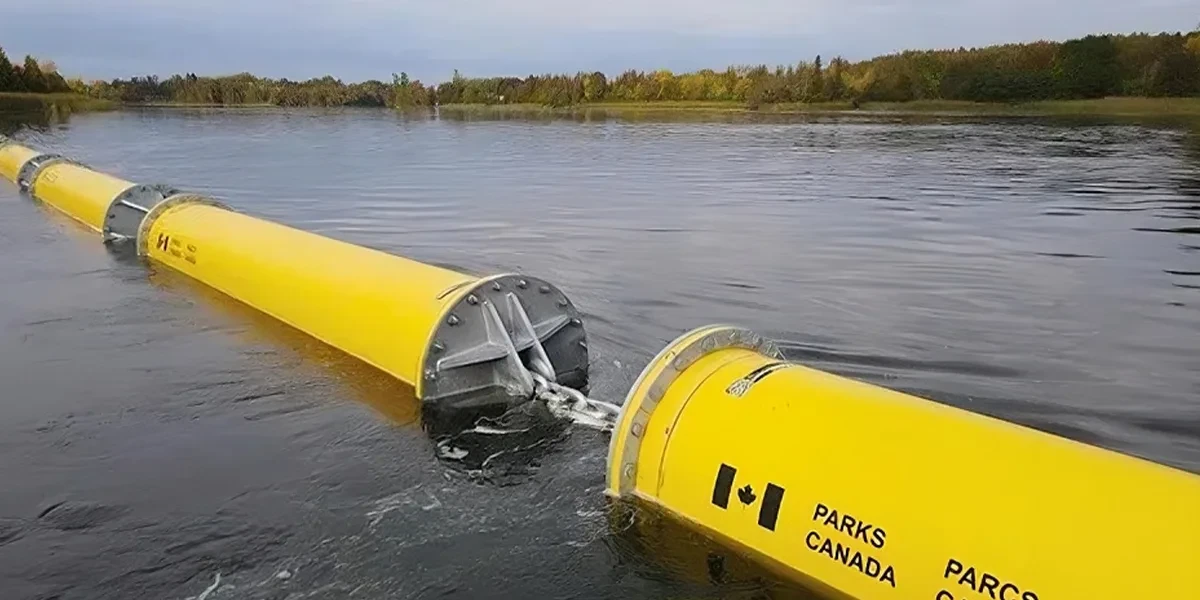
Floating Barriers are engineered systems installed across rivers, canals, stormwater drains, lakes, and industrial waterways to intercept floating debris before it spreads downstream.
Think of them as intelligent checkpoints for water bodies.
They do not stop the water flow. They stop floating waste.
Plastic bottles. Water hyacinth. Packaging waste. Styrofoam. Organic matter. Urban litter. Industrial floating residue.
Captured. Concentrated. Removed efficiently.
Modern floating debris boom systems are designed to withstand changing water levels, high flow conditions, monsoon pressure, and continuous debris loads without disrupting aquatic movement or hydraulic flow patterns.
That balance matters enormously in Indian River conditions.
Because Indian rivers are not static systems. They swell violently during monsoon months. They shrink during dry periods. They carry mixed waste streams, unlike many Western waterways.
A rigid system fails quickly here.
Adaptive floating systems survive.
There is a misconception that floating waste is merely cosmetic pollution.
It is not.
Floating debris becomes a multiplier problem.
Here’s how.
Plastic waste blocks drainage infrastructure. Organic waste reduces dissolved oxygen. Floating vegetation traps sewage solids. Debris islands slow water movement and accelerate bacterial growth. During floods, accumulated waste can damage bridges, pumping stations, and embankments.
One neglected drain can contaminate kilometers of river stretch downstream.
Delhi has already seen how unmanaged drains contribute massively to the Yamuna pollution. CPCB observations showed multiple drains discharging untreated sewage into the river system.
Now imagine combining untreated wastewater with tons of floating urban waste.
That creates surface pollution layers capable of worsening oxygen depletion and visible frothing.
Not surprisingly, dissolved oxygen levels in parts of the Yamuna have approached near-zero conditions in certain stretches.
Aquatic ecosystems collapse under those conditions.
Fish die. Algae blooms rise. Odor intensifies. Public trust disappears.
This is exactly why floating debris systems are becoming central to urban river management strategies across Indian municipalities.
Old river cleanup models focused heavily on downstream cleaning.
Collect waste after it spreads.
The flaw is obvious.
Once floating debris disperses across large river sections, recovery costs rise exponentially. Collection efficiency drops. Microplastic fragmentation increases. Shoreline contamination expands.
Modern river engineering prefers interception.
Prevent the spread first. Recover faster.
That is where floating boom barriers offer extraordinary operational value.
Installed strategically near drain outfalls, bridge points, industrial discharge channels, or urban river junctions, these systems create controlled collection zones where debris naturally accumulates for periodic removal.
Less manpower. Better efficiency. Lower operational cost.
Quite frankly, it is common-sense engineering.
Delhi’s Yamuna crisis has become a national warning sign.
Only about 2% of the Yamuna’s total river length flows through Delhi, yet this stretch contributes nearly 80% of the river’s pollution burden, according to a Centre for Science and Environment analysis.
That statistic should disturb every urban planner in India.
Because it proves one thing clearly: concentrated urban pollution zones can destroy entire river ecosystems.
The government has increased intervention efforts. Floating skimmers, drain pontoons, desilting operations, and sewage infrastructure upgrades are now underway.
But large-scale river recovery cannot rely only on sewage treatment plants.
Surface waste interception is equally critical.
Without controlling floating waste inflow, even treated waterways continue accumulating visible pollution loads.
People judge river health visually first.
If citizens still see plastic islands, floating garbage, and froth-covered surfaces, trust in restoration efforts collapses.
That perception matters politically, environmentally, and socially.
The Cooum River presents another layer of complexity.
Unlike inland river systems, coastal urban rivers eventually transfer floating waste into marine ecosystems. Once debris reaches estuaries and coastal waters, retrieval becomes dramatically harder.
Marine litter does not stay local.
It spreads across fisheries, beaches, mangroves, and ports.
Floating interception systems installed upstream can significantly reduce coastal pollution transfer rates.
This is why proactive floating debris control infrastructure is increasingly viewed not merely as waste management equipment, but as environmental protection infrastructure.
The distinction matters.
One treats symptoms.
The other protects ecosystems.
Indian waterways are tough environments for infrastructure.
Heavy monsoons. Variable currents. High sediment loads. Mixed waste streams. Unauthorized dumping. Extreme heat. Corrosion risk.
A poorly designed barrier system can fail quickly.
That is why advanced floating debris boom solutions require:
Floating barriers operating in Indian rivers must handle unpredictable flow conditions, sudden monsoon surges, and continuously changing water levels without losing structural balance.
A high-buoyancy design ensures the system stays afloat and functional even under heavy debris loads, preventing overflow or submergence during peak pollution events.
This stability is critical for uninterrupted debris interception in fast-moving urban waterways and drainage channels.
Urban waterways in India often contain chemically contaminated wastewater, industrial discharge, sewage content, and saline pollutants that rapidly degrade ordinary materials.
Corrosion-resistant barrier systems use durable polymers, treated metals, or marine-grade materials designed for long-term exposure to harsh aquatic environments.
The result is longer operational life, lower replacement costs, and consistent performance in demanding river conditions.
River currents in India can shift dramatically during rainfall and flood events, placing immense pressure on fixed infrastructure.
Flexible anchoring systems allow floating barriers to adapt naturally to changing flow dynamics without snapping, drifting, or creating structural stress points.
This engineered flexibility improves durability, protects surrounding infrastructure, and ensures reliable operation during extreme hydraulic conditions.
Municipal authorities and industrial operators require floating debris systems that are simple to manage, easy to access, and efficient to clean regularly.
Low-maintenance designs reduce manual labor requirements, minimize downtime, and simplify debris removal operations even in heavily polluted water bodies.
Practical maintenance efficiency becomes especially important for large-scale urban deployments operating continuously throughout the year.
An effective floating barrier must capture large volumes of floating waste while still allowing uninterrupted water movement through the channel.
Poorly designed systems can obstruct flow, increase flood risks, or allow debris escape during high-current conditions.
Advanced debris retention engineering creates an optimized balance between waste interception, hydraulic performance, and environmental safety.
This is where specialized environmental engineering firms like Yooil Envirotech bring critical technical expertise into municipal and industrial water management projects.
Not every barrier works everywhere.
Hydrology matters. Waste profile matters. Flow velocity matters.
Real environmental engineering is site-specific.
Ten years ago, many cities viewed river barriers as optional add-ons.
Not anymore.
Climate variability and urban waste generation have changed the equation.
India generates millions of tonnes of plastic waste annually, while urban stormwater systems continue carrying unmanaged solid waste into rivers during rainfall events.
One intense monsoon week can undo months of manual cleanup operations.
So municipalities increasingly need permanent interception systems.
Reliable. Scalable. Visible.
And frankly, citizens notice visible intervention infrastructure. Floating barriers demonstrate active pollution control efforts in real time. That public visibility creates accountability.
People want proof.
Not presentations.
No single technology can clean Indian rivers completely.
Not sewage treatment plants alone. Not skimmers alone. Not dredging alone.
Real recovery needs layered intervention systems:
Within that ecosystem, floating debris systems play a frontline containment role.
They are not the final solution.
They are the first defense.
And first defenses save ecosystems from escalating damage.
This conversation is bigger than waste collection.
It is about how cities relate to water.
For decades, urban rivers were treated like drainage channels. Out of sight. Out of policy focus. Out of civic imagination.
That attitude failed spectacularly.
Now cities are rediscovering something obvious: healthy rivers are economic assets, public health assets, climate resilience assets, and social assets.
Clean rivers improve urban life.
Simple truth.
Technologies like Floating Barriers may seem modest compared to billion-rupee infrastructure announcements, but practical interventions often create the most visible impact on the ground.
And honestly, visible improvement matters. Citizens need to see rivers recovering.
Otherwise environmental policy starts feeling abstract.